A Beginner's Guide to Building a Custom Sound System
Why a stock system sounds the way it does
The factory system in your 2018 Camry was designed by accountants, not audio engineers. It uses paper-cone speakers, an under-powered head unit, and zero sound deadening. It is good enough to hear talk radio. It is not built to play music loud and clean.
A custom system replaces the weak links one at a time.
The signal chain — every car audio system has these parts
- Source unit — head unit, phone Bluetooth, Apple CarPlay. Sends the audio signal.
- Signal processor (optional but huge) — a DSP corrects for the car's bad acoustics: time alignment, EQ, crossovers.
- Amplifier(s) — take the small signal and deliver real wattage to the speakers.
- Speakers — turn electrical energy into sound. Components (tweeters + mids), coaxials, or subwoofers.
- Sound deadening — Sound Shield mats on door skins and floors. Reduces resonance.
If any one of these is the bottleneck, the whole system sounds like that bottleneck.
Picking your front stage
Your front stage is everything. We always recommend component sets (a separate tweeter and a mid-bass driver) over coaxials for the front doors. Tweeters get mounted in the A-pillars or sail panels at ear height, which makes the soundstage rise to dash level.
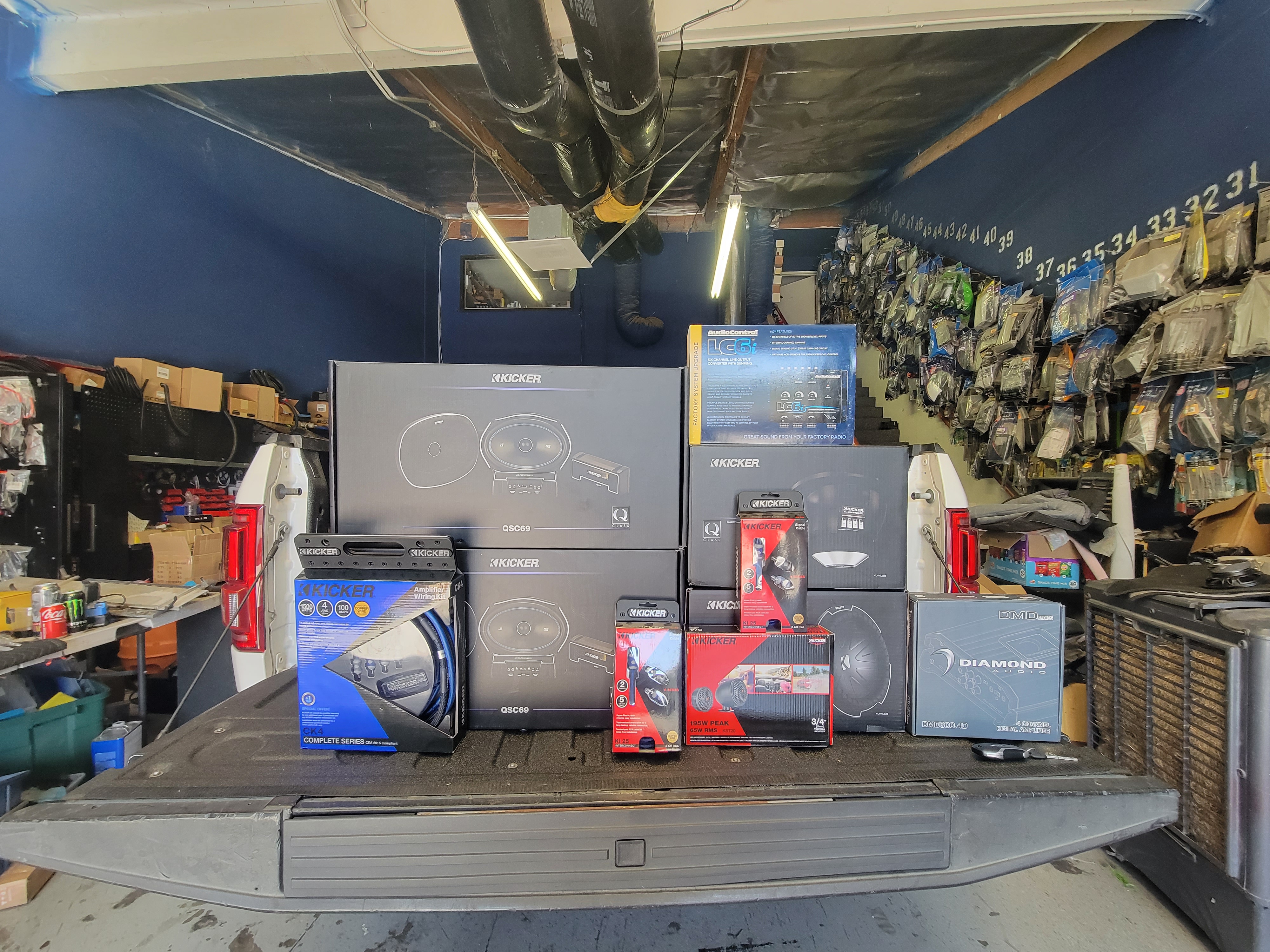
Brands we install daily: Alpine, Kicker, Audio Control, JBL, JVC.
Subwoofers — sealed vs ported
- Sealed box: tight, accurate, "musical." Good for rock, jazz, hip hop with clean kicks. Smaller footprint.
- Ported box: louder, boomier, more output per watt. Good for trap and bass-heavy genres. Bigger box.
A common mistake is throwing a ported 12" into a tiny trunk and wondering why it sounds like cardboard. Match the enclosure to the sub spec sheet, not Instagram.
Why DSP matters in a car
A car cabin is the worst environment to play music. Speakers are inches from the driver and feet from the passenger, so the left and right channels arrive at different times. A digital signal processor time-aligns the channels so the stereo image lands centered on the rearview mirror. This is what separates a "loud" system from a "great" system.
A starter build path
- Step 1: Front components + sound deadening ($600–$900).
- Step 2: 4-channel amp ($650-950).
- Step 3: Subwoofer + mono amp ($600–$900).
- Step 4: DSP + tune ($600–$1,200).
You can stop after any step and have a complete, balanced system.
Free consult
Want help mapping your build to your music taste and budget? Book a free in-shop consult. We will plug your phone into a demo car, let you hear what each step adds, and write you a real quote.
Ready to book?
Same crew that wrote this post handles every install. Text or call for a quote.